Studio 4 - Usability Tools
For this assignment I will be analysing one my mobile phones which is the Sony Ericsson K750i.


The K750i is a fully featured phone with video camera, digital music player, FM Radio, Bluetooth, memory stick, triband and etc. It nearly has everything what a person would be looking for in a mobile phone.
Affordances
This phone is simple and quite straight forward to understand. It’s not very hard to use but does have a few stuff that could make an individual confused in terms of how some of the material works.
The screen is clear and the keys are basic to see. The size of the phone is nice and small so it is easy to fit in your pocket and light to carry.
Mappings
The buttons are quite straight forward but there are some problems with the button which could confuse a person at first in how to answer or how to end a call.
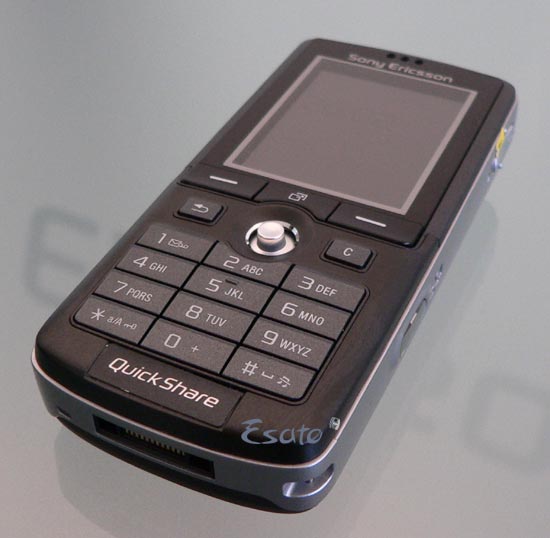
From the picture for “Answer call” and “End call” the signs they have used is “ - “ which don’t really clarify that these are the buttons to answer a call or to end a call. Otherwise for the keypad it is simple and easy to use, also the navigation button (the cursor) is effortless for example if you move up or down then it will scroll up and down, its just that simple.
Constraints
The charger for this phone is designed so that it can simply be inserted correctly. This is achieved by its shape so that it won’t be able to fit in any other way but the port of the charger could made easier for a being to know which way it gets inserted in for example they could of put a Lettering or a sticker stating which is the right way to connect the charger to the phone.
Conventions
The only fault I would say as a convention is again is to pick up a call and to end a call which is the only convention I found which is not followed, traditionally in older phones it was they used the colour “green” to answer calls and “red” to end calls. Otherwise I can not see any other conventions and the phone is quite straight forward to use by a human being who is in need of a decent mobile phone.
The charger for this phone is designed so that it can simply be inserted correctly. This is achieved by its shape so that it won’t be able to fit in any other way but the port of the charger could made easier for a being to know which way it gets inserted in for example they could of put a Lettering or a sticker stating which is the right way to connect the charger to the phone.
Conventions
The only fault I would say as a convention is again is to pick up a call and to end a call which is the only convention I found which is not followed, traditionally in older phones it was they used the colour “green” to answer calls and “red” to end calls. Otherwise I can not see any other conventions and the phone is quite straight forward to use by a human being who is in need of a decent mobile phone.
What’s a Scenario?
It’s a story of how an imaginary person might need to work with a technology. For example ‘John is in the Quit Zone on the Virgin train. He wants to check his texts but to do that he has to stop his phone making any noise. So he has to switch off all the sounds.
In order to do this he has to unlock his phone first by clicking the hash button and then click on the answer button, by doing this the phone will unlock which the phone does guide the user by displaying on screen on how to unlock it. After this he clicks on menu and scroll down to find "silent mode" which he clicks on, once he has clicked on the silent mode the phone would vibrate to notify the user it is on silent now.
What's a Function?
In our culture, green means 'go', and red means 'stop'. This is a cultural constraint, that is, an arbitrary learned convention that we all understand - one of Norman's design principles. It makes sense, then, to apply this as a design principle to the start/ end call functions, as people associate green with starting and red with stopping. At the same time, because we read from left to right, what is on the right comes after what comes on the left, so again it makes sense to put the stop button to the right of the start button, as we end a call after we have started it (indeed it is impossible to do otherwise!). This again shows that a cultural constraint (a different one) has been used in the design, so two different cultural constraints have been used for the function.


No comments:
Post a Comment